
DENTAL IMPLANTS
The Importance of Replacing Missing Teeth
Your teeth affect your overall health and quality of life. When a tooth is missing, it can affect your bite, speech, and ability to eat comfortably. Relying more heavily on your remaining teeth can also place additional stress on them, potentially contributing to premature wear, damage, or further tooth loss. Some patients may also experience headaches or jaw discomfort.
After a tooth is lost, the jawbone in that area can gradually shrink because it is no longer being stimulated by the tooth root. This can make future tooth replacement more complex as time passes. Dental implants help replace the missing tooth root while supporting a natural-looking replacement tooth. Your dentist and implant surgeon can discuss your options and help determine the best approach for restoring your oral health, function, and appearance.
What Are Dental Implants?
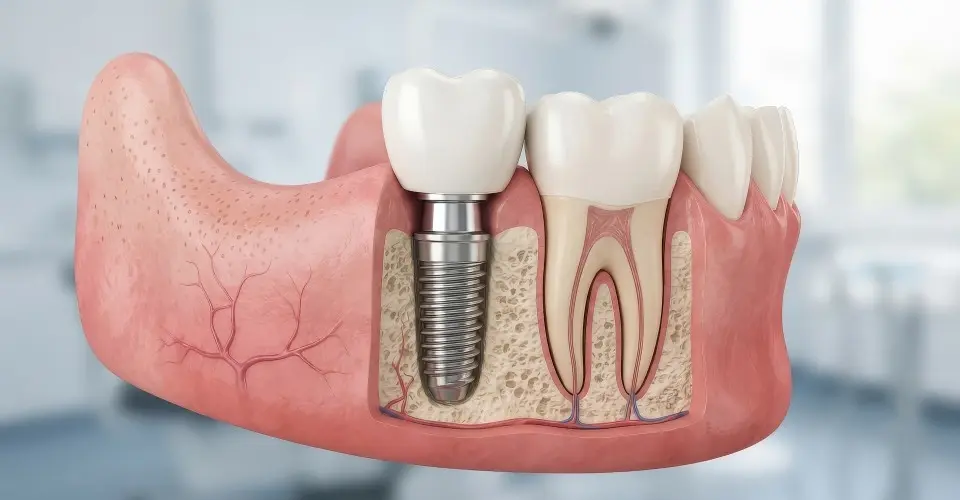
A natural tooth consists of a root and a crown. If you compare natural teeth to implant-supported replacement teeth, you'll see they share the same basic parts. Both have a crown, the visible part used to chew food, and both have a root that holds the tooth securely beneath the gum and anchors it into the jaw. The difference is that a dental implant root is made of titanium, a time-tested material also used in many other medical applications.
When you lose a tooth, you lose both the root and the crown. To replace it, the surgeon first places a small dental implant into the jawbone to serve as an artificial tooth root. Time is then allowed for the bone to heal and grow around the implant. The bone bonds with the titanium, creating a strong foundation for the replacement tooth. A support post, called an abutment, is then placed on the implant, and a replacement tooth or crown is secured on top.
In some cases, a temporary replacement tooth may be attached soon after the implant is placed. When multiple teeth or all of the teeth are missing, dental implants can also be used to support bridges, dentures, and full arches of replacement teeth. For patients who have lost most or all of their teeth, All-on-X dental implants can provide a fixed, implant-supported solution using strategically placed implants to support a full arch of replacement teeth.
Why Select Dental Implants Over Traditional Restorations?
There are several reasons patients may choose dental implants over traditional tooth replacement options. A traditional dental bridge may require modifying the structure of surrounding healthy teeth to support the replacement tooth. Removable dentures and partial dentures can also move during eating or speaking and may require removal for cleaning and overnight wear.
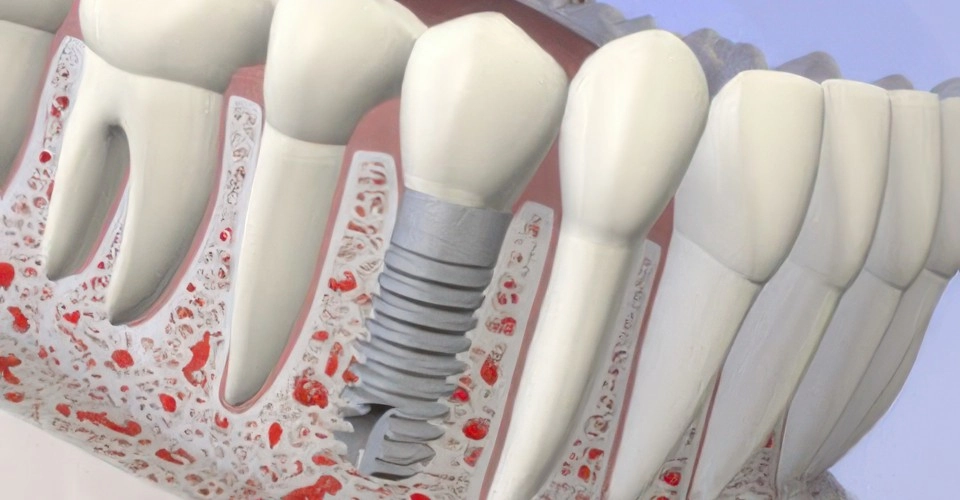
Dental implants are anchored into the jawbone and can provide a stable foundation for individual replacement teeth, bridges, or implant-supported dentures. They are designed to function much like natural tooth roots while helping support the surrounding jawbone.
Tooth Replacement Options & Candidacy
Patients have several options for replacing missing teeth, ranging from temporary solutions to long-lasting implant-supported restorations. Your oral and maxillofacial surgeon and restorative dentist can evaluate your needs and recommend the most appropriate treatment.
Dental implants may be an option for people who are missing one or more teeth or who are looking for an alternative to traditional dentures. Age alone is not necessarily a limiting factor. However, factors such as smoking, certain health conditions, and previous radiation therapy to the head or neck may affect implant treatment and healing.
Your surgeon will evaluate your teeth, gums, and jawbone to determine whether you have enough bone to support an implant. X-rays and three-dimensional imaging may be used to assess the bone and surrounding structures and determine whether additional procedures, such as bone grafting, may be needed before implant placement.
Surgical Advances
Using modern dental implant technology and surgical techniques, Dr. Byron Black and Dr. William Black are able to place a variety of implant systems based on each patient's individual needs. In certain cases, single-stage implants may be placed without requiring a separate procedure to uncover the implant. A healing period is still required before the final replacement tooth is attached.
In appropriate situations, an implant may also be placed at the same time as a tooth extraction. This approach can help streamline treatment and may reduce the number of separate surgical procedures required.
A Collaborative Team Effort
Dental implant treatment is a collaborative process between an oral and maxillofacial surgeon and a restorative dentist. Dr. Byron Black or Dr. William Black performs the implant surgery, initial tooth extractions, and any necessary bone grafting or other surgical procedures.
Your restorative dentist is responsible for designing and fitting the permanent replacement teeth, as well as any temporary prostheses needed during the treatment process. Working together, your dental and surgical teams can coordinate treatment to provide a stable and functional result.